
Moore Art Gallery, Capers Hall, The Citadel
On view from January 22 – May 8, 2026
Opening reception from 5-7 pm on Thursday, January 22
Gallery hours: Monday – Friday, 10 am – 3 pm
NOTE: The gallery will be closed March 9-13 for Citadel Spring Furlough
https://today.citadel.edu/moore-art-gallery-opens-all-hands-on-deck-wwii-naval-photography-exhibit
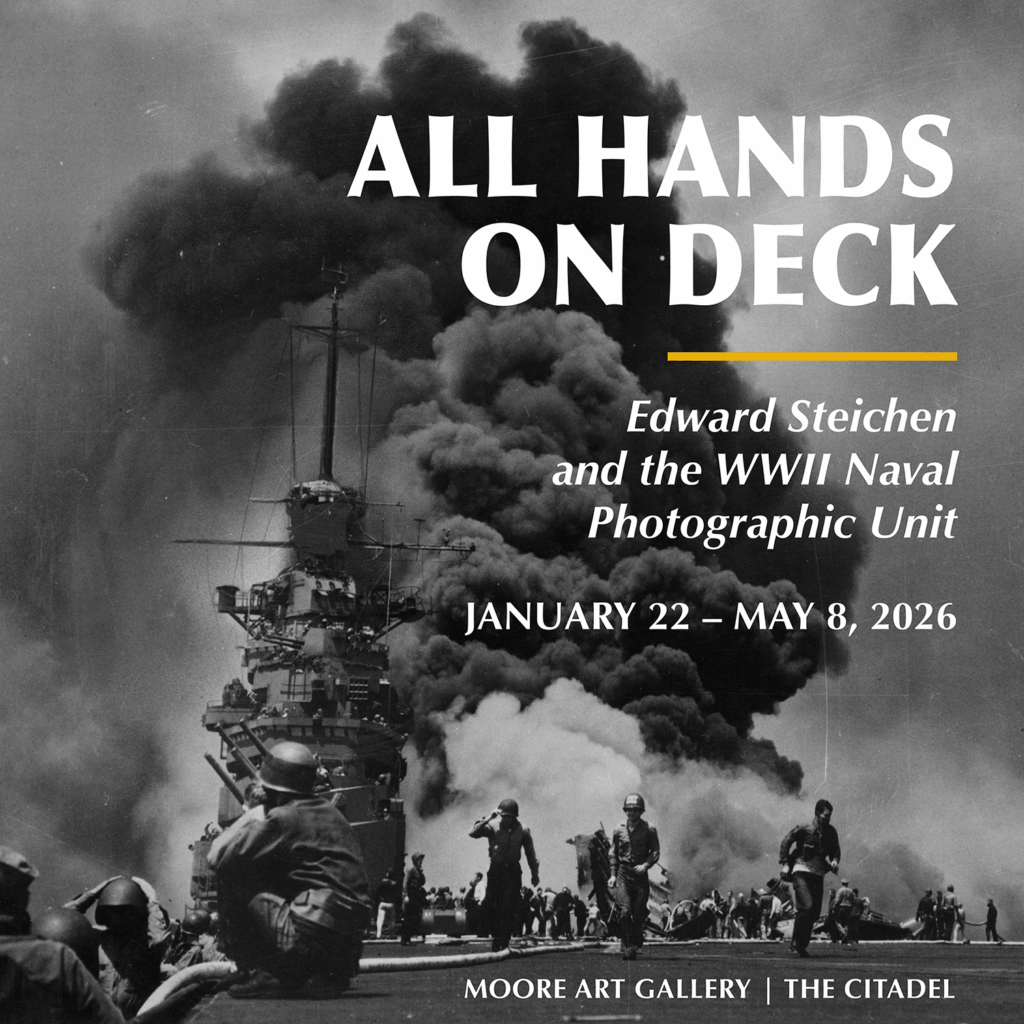
Set against the sweeping backdrops of the ocean and the sky, Edward Steichen and the members of his Naval Photographic Unit captured stunning eyewitness images of epic moments in World War II that continue to resonate more than 75 years later. Steichen, who had served in the first World War in the photographic reconnaissance division of the Army Signal Corps, understood the power of documentary visual data. Also, as a celebrated photographer for Condé Nast publications like Vogue and Vanity Fair and a photography curator at the Museum of Modern Art (MoMA), he knew how to align geometry, emotion, and action in a fleeting second to express the essence of a story, requiring patience, anticipation, and a keen eye for composition.
At age 62, Steichen was recruited back to service as a Lieutenant Commander in the Navy’s Training Literature Division to produce images that would draw attention to their aviation program. He assembled the “Steichen Unit,” an expert team of photographers and technicians whose work became so well known that their services were requested in combat operations, including by Captain J.J. “Jocko” Clark as he took command of the USS Yorktown. Steichen famously gave the mission to his unit as, “Don’t photograph the war, photograph the man, the little guy; the struggle, the heartaches, plus the dreams of this guy. Photograph the sailor.” Each photographer would send Steichen their film and he would have it developed and printed according to his exacting professional standards. Wielding a grease pencil, Steichen wrote directly on the prints of how they were to be cropped and printed for major news outlets. Although Navy regulations prohibited individual photographer credit, some records were kept to identify the work of Charles Kerlee, Horace Bristol, Charles Jacobs, Victor Jorgenson, Wayne Miller, and Dwight Long. With Long as the supervisor, Steichen also produced The Fighting Lady: A Drama of the Pacific, which won an Oscar for Best Documentary in 1945 and will be screened at The Citadel as part of this exhibit on March 26.
As the war came to a close, Steichen was named director of the newly-created Naval Photographic Institute to oversee over 4,000 Navy combat photographers. He left active duty in October 1945 and was awarded the Navy’s Distinguished Service Medal, commending his “exceptionally meritorious” service. Shortly thereafter, at age 68, Steichen became the director of photography at MoMA where he continued to showcase combat photography in an artistic setting. After his death in 1973, the combat prints from his personal collection, many bearing his original markings, were bequeathed to MoMA. Groups of these study prints have been recently donated to Naval institutions around the country, including Patriots Point Naval & Maritime Museum, to increase public access to these national treasures. Now, for the first time, these striking images of war and the people who fought it can be seen as Steichen intended, making the drama of ordinary men in extraordinary events feel as immediate now as when they were first captured on film.
***
Drawn from both their archives and a recent gift from the Museum of Modern Art to Patriots Point Naval & Maritime Museum, this exhibit was curated by Tiffany Reed Silverman with the generous collaborative support of the staff of Patriots Point Naval & Maritime Museum, especially Meredith Kablick, Miranda Helton, Colby Causey, Joe Bosco, and Kenny Brinckman and Citadel interns Camden Hom and Aidan Wiseman. Additional support was provided by Pinnacle Bank and the Friends of Fine Arts at The Citadel.